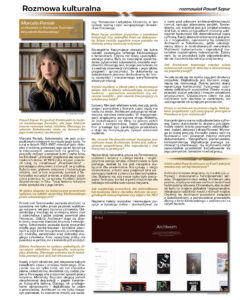
“Kompas Kulturalny”, a supplement devoted to the culture and heritage of the region and published with the regional newspaper “30 minut”, has published an interview with Marcela Paniak, archivist at the Krzysztof Kieślowski Archive.
In conversation with Paweł Szpur, Marcela Paniak discusses the particular significance of Sokołowsko in Krzysztof Kieślowski’s biography and the reasons why the Archive dedicated to his work is located there today. Sokołowsko was part of Kieślowski’s childhood and was connected with his father’s treatment for tuberculosis. Years later, the director returned to the village to make his documentary film X-Ray.
One of the main subjects of the interview is the everyday work involved in preserving and cataloguing Kieślowski’s legacy. The Archive contains photographs, typescripts and successive versions of screenplays, handwritten notes, correspondence, production documents, posters, and materials relating to projects that were never realised. Together, these objects make it possible to approach a film not only as a finished work, but also as the result of a long creative process involving revisions, conversations, abandoned ideas and changing decisions.
The interview also addresses the digitisation and cataloguing of the collections and the ways in which they can be made accessible to researchers, students, authors, filmmakers, artists and anyone interested in Kieślowski’s work. The Archive’s online database is being continuously expanded as further materials are identified, described, organised and prepared for access.
The conversation also looks toward the future of the Archive. One of its long-term ambitions is to develop Sokołowsko as a place combining the preservation of Kieślowski’s material legacy with research, education, artistic activity and international exchange devoted to his work.
Read the full interview:
https://www.30minut.pl/
Read the full issue of “Kompas Kulturalny”:
https://www.30minut.pl/2026/08/